|

|

|
Gold Seal Lesson:
Speed Trap
|
|
|
|
Copernicus
Education Gateway
|
|
|
|
Subject:
|
|
|
Mathematics
|
|
Grade:
|
|
|
5-8
|
|
|
|
|

|
|
ICLE Standards:
|
|
|
Mathematics as Problem Solving: Acquire
confidence is using mathematics meaningfully; generalize solutions and strategies to new problem situations.
Computation and Estimation: Compute with whole
numbers, fractions and decimals.
Statistics: Construct, read and interpret
tables, charts and graphs.
|
|
|
|
|
|
|
Performance Task:
|
|
|
In Big Town, Michigan, the speed limit is 45 mph.
To determine a fine for a person caught speeding, the driver's clocked speed is rounded to the next multiple of 5. That is, if a
driver is clocked at 52 mph, his/her speed would be rounded to 55 mph to determine his/her fine. The fine for a
speed of 50 mph is $60. For every five miles above 50 mph, the fine is increased by 15 percent of the
fine at the previous level. The fine is rounded to the nearest dollar. Speeders clocked above 75 mph are fined a
flat rate of $150. After completing the attached table, construct a graph that shows the fine for all possible
clocked speeds.
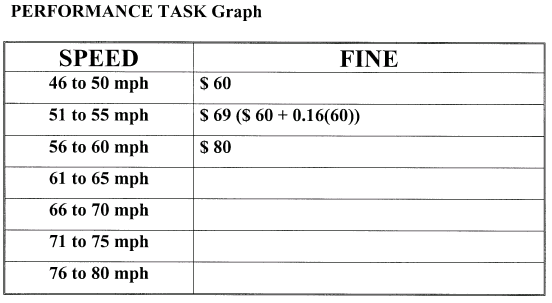
This graph is called a step graph. Explain why this is an appropriate name
and give two other examples of data, which, when pictured, would produce a step graph.
|
|
|
|
|
|
|
Knowledge / Skills:
|
|
|
Perform operations with signed (positive and
negative) numbers, including decimals, ratios, percents, and
fractions. (m1)
Understand the best procedures for statistical
data collection, organization, and display. (m5)
|
|
|
|
|
|
|
Rubric:
|
|
|
4 Points = The student independently responds to all parts of the task. He/she completes the table accurately and constructs a neat and accurate graph. The student can explain why “step graph” is a good name for this type of graph and gives two examples of data that would also produce a step graph when pictured.
3 Points = The student needs some coaching to respond to all parts of the task. He/she completes the table, but has some arithmetic inaccuracies. The student has difficulty explaining the name “step graph” and can give only one example of data that would also produce a step graph when pictured.
2 Points = The student is unable, even with coaching, to complete all parts of the task. He/she has several inaccuracies in the table, which, when graphed, does not produce a good step graph. The student cannot explain the meaning of “step graph” and can not give another example of data that would
produce a step graph when pictured.
1 Point = The student is unable to complete the table. Hence, he/she cannot draw the required graph. The student has little understanding of the mathematical ideas of the problem and cannot respond to any
of the questions based upon the graph.
|
|
|
|
|
|
|
Keywords:
|
|
|
STATISTICS
DATA ANALYSIS
DATA COLLECTION
GRAPHS
STATISTICS IN DAILY LIFE
TABLES
COMPUTATION
|
|
|
|
|
|
|
Grades:
|
|
|
Kg [] - 1 [] - 2 [] - 3 [] - 4 [] - 5 [x] - 6
x] - 7 [x] - 8 [x] - 9 [] - 10 [] - 11 [] - 12 []
|
|
|
|
|
|
|
ICLE Application:
|
|
|
D
|
|
|
|
|
|
|
|
|
|
© 2000 International
Center for Leadership in Education
1587 Route 146 - Rexford - NY - 12148
518.399.2776 Fax: 518.399.7607
101
|
|
|
|
|
|
|