|
ICLE Standards:
|
|
|
Physical Science: Develop an understanding of
motion and forces.
Algebra: Relate concrete, numerical and graphic
models to algebraic formulas.
Patterns and Functions: Represent situations and
number patterns with tables, graphs, verbal rules and equations, and translate among these representations.
Problem Solving: Solve real-world problems
involving substitutions in expressions and formulas.
|
|
Performance Task:
|
|
|
You have two options from which to choose for this
task. Each task requires you to integrate and relate your science and
mathematics learning. Both options require you to find the average speed
and acceleration of a moving object. Choose one of the following two
options:
Option 1: Average speed and acceleration of a track runner
This task should be done in groups of six students. Each group will need
one stop watch and one measuring device. Go out to the running track. One
student is the runner. Another student is the timer. The other four group
members are distance trackers. The distance trackers spread out about 20
steps from each other along the track. That is, tracker one stands about 20
steps from the starting line, tracker two 40 steps, tracker three 60 steps,
and tracker four 80 steps. The runner gets behind the starting line. The
timer yells, "Ready, set, go!" and starts the stop watch. The
timer yells, "1" at one second, "2" at two seconds,
"3" at three seconds and "4" at four seconds after the
start. Tracker one observes and stands at the runner's point when the timer
yells, "1" Tracker two does the same at the two-second mark.
Trackers three and four mark the runner's progress similarly. Using a measuring device, measure to the
nearest meter the runner's distance from the starting point at each mark.
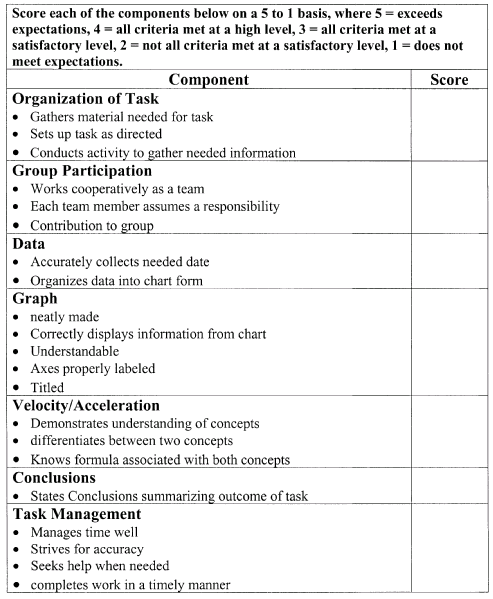
Make a table showing the runner's distance at zero seconds, one second, two
seconds, etc. Construct a graph, showing distance as a function of time.
Predict what the distance would be at five seconds. Explain your prediction. Find the average velocity for one second, two seconds,
three seconds and four seconds. Show how you found the average velocity. If you used a formula, state the formula used.
Construct a graph showing average velocity as a function of time. Calculate
the acceleration that occurs in each passing second. Show or explain how
you found the acceleration. If you used a formula, state the formula used. State all
conclusions that you can make from your results.
Option 2: Average speed and acceleration of a toy car This task should be
done in groups of six students. Each group will need one stop watch, one
measuring tape, one toy car and one long board. One student is the starter.
One person is the timer. The other four people are trackers. Two trackers
should get on one side of the ramp and the other two trackers on the other side. The starter stands at the top of the ramp. Using the board, set
up a ramp with a slight slope. The toy car should be able to start without
a push, but should not go off the ramp before four seconds have elapsed.
Put a piece of masking tape about 5 cm from the top of the ramp to mark the
"starting line." Experiment with your ramp until you get an
appropriate slope and length. When the ramp and all six students are ready to begin,
the timer says, "Ready, set, go!" On "go," the starter
releases the car and the timer starts the stop watch. The starter should
not push the car; just release it. The timer says "1" when the
stop watch gets to one second, "2" at two seconds, "3"
at three seconds, "4" at four seconds. Tracker one observes and
places a finger at the one second mark. Trackers two, three and four do the
same at their respective times. With the measuring tape, the timer and
starter measure to the nearest centimeter the distance for each second. Make a table showing the car's distance at zero, one, two, three and four
seconds. Construct a graph showing distance as a function of time. Predict
what the distance would be at five seconds. Explain your prediction and
note any patterns you notice on the table and/or graph. Find the average velocity for one
second, two seconds, etc. Show how you found the average velocity. If you
used a formula, state the formula used. Construct a graph showing average
velocity as a function of time. Calculate the acceleration that occurs in each passing second. Show
or explain how you found the acceleration. If you used a formula, state the
formula used. State all conclusions that you can make from your results.
|
|
Knowledge / Skills:
|
|
|
Measure properties of the environment using
dimensional quantities such as time, length, mass, pressure, volume,
acceleration, etc. Compare quantities and consider the error involved with
measuring environmental properties.
(s23)
Exhibit good data management skills by
collecting, organizing, and graphing data.
(s19)
Participate, sometimes leading, in group
meetings by contributing, taking turns speaking, and working toward a
common goal. (ela20)
|