|
ICLE Standards:
|
|
|
Statistics: Systematically collect, organize and
describe data; construct, read and interpret tables, charts and graphs; make inferences and convincing arguments based on data
analysis.
Mathematics as Communication: Use oral and
written skills to communicate mathematical findings.
|
|
Performance Task:
|
|
|
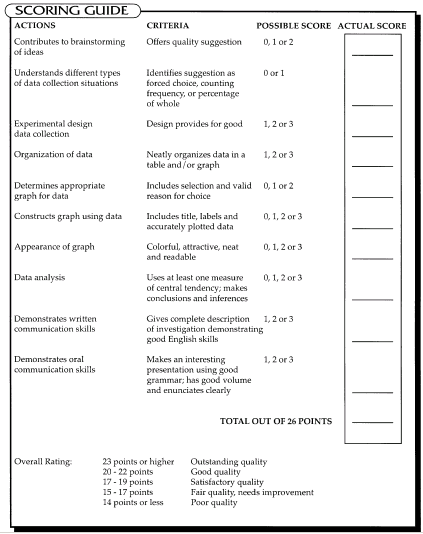
This task requires you to collect data in a
real-world situation. As a class, brainstorm things that would be interesting to investigate. Be creative and interesting. Ideas put forth
should represent each of the following types of situations:
-
Forced choice, where there are a limited number of responses. For
example, favorite sport from among baseball, hockey, basketball, football and soccer.
-
Counting frequency of occurrence of an event over a period of time. For
example, the number of cars that pass your house between 5 and 5:30 p.m. for one week.
-
Percentage of the parts of a whole. For example, the number of each
color in Skittles R packages.
After the brainstorming session, select one of the proposed ideas, or with
the permission of your teacher, select one of your own to investigate. You may join with one or two other
students who wish to investigate the same idea as you do. Design an experiment that will allow you to
collect the necessary data for your investigation. Conduct the experiment and gather the data. Organize your
data in a chart or table.
Make a graphic display of your data. Choose the graph that you feel is most
appropriate for your data.
Your graph should be large enough for someone at the back of the room to see
(poster board works great). Label the axes. If you wish, you may use a graphics software program to
generate your graphs. Be sure to title your graph. Your graph should be colorful, attractive, neat and
readable. It should have enough information to interpret and draw conclusions.
Using the data in your chart or table and your graphic display, analyze the
data. Use at least one measure of central tendency in your analysis. What conclusions or inferences, if
any, can you make from your investigation?
Write a written report describing your investigation. Discuss any problems
that you encountered or any circumstances that may have affected your data. State any inferences or
conclusions you made. Be specific and precise. State any strengths or weaknesses of your study. Make a
presentation of your investigation and results to the whole class. You should explain your investigation,
discuss your findings and present it in an interesting way. Watch your volume, enunciation and grammar. Allow
your classmates to ask questions and make comments about your investigation and presentation.
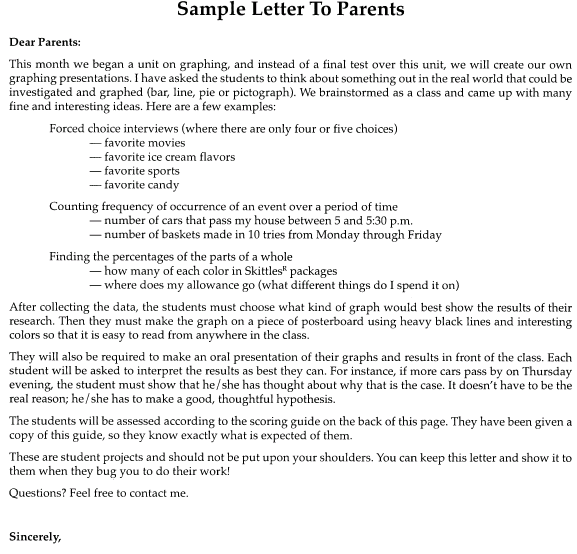
Note to teacher: A parent letter is included should you wish to use one.
|
|
Knowledge / Skills:
|
|
|
Perform operations with signed (positive and
negative) numbers, including decimals, ratios, percents, and fractions. (m1)
Understand the best procedures for statistical
data collection, organization, and display. (m5)
Understand the characteristics of measures of
central tendency (i.e., mean, median, and mode). (m15)
Present information in well-organized fashion
that will be clear to the target audience.
(ela11)
|