|

|

|
Gold Seal Lesson:
Going Around In
Circles
|
|
|
|
Copernicus
Education Gateway
|
|
|
|
Subject:
|
|
|
Mathematics
|
|
Grade:
|
|
|
5-8
|
|
|
|
|

|
|
ICLE Standards:
|
|
|
Mathematics as Communication: Reflect on and
clarify thinking about mathematical ideas and situations.
Mathematical Connections: Explore problems and
describe results using graphic, numerical, physical, algebraic, and verbal mathematical models or representations.
Patterns and Functions: Describe and represent
relationships with tables, graphs, and rules.
Geometry: Use circle concepts and measurement to
understand the relationship between direct variation and slope.
|
|
|
|
|
|
|
Performance Task:
|
|
|
Note to the teacher: For this activity, it is best
that students work in groups of 2 or 3.
Your task is to investigate the relationship between the diameter and
circumference of a circle. Select 10 circular shapes of different sizes. Some samples of circular shapes are
dowel rods, tin cans, round clocks, etc. Using metric rulers and tape measures, measure, to the nearest
millimeter, the diameter and the circumference of each circular shape you choose. Record your measures in
the first two columns of the table below.
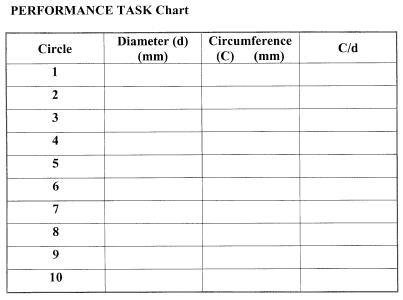
Using a calculator, compute the value of C/d for each circle measured.
Record your answer in the third column of the table. In your math journal, explain why the relationship
between the diameter and circumference appears to be an example of direct variation. State the
approximate constant of variation and write an equation to model the relationship between circumference and
diameter using C, d, and your constant of variation.
On a piece of graph paper, graph the function showing the relationship
between the diameters and the circumferences for the 10 circles. Use the x-axis for diameters and the
y-axis for circumferences. Draw the line of best fit for the points you plot. Choose two points from your
fitted line whose values you can easily read and find the slope of your fitted line using these two points. Repeat
this for two other pairs of points on your line. In your math journal, compare this value, which is the slope
of your line, with the constant of variation found earlier in the activity. Write a summary of your findings in your journal.
|
|
|
|
|
|
|
Knowledge / Skills:
|
|
|
Understand the properties of circles (e.g.,
radius, arc, diameter, chord, secant, tangent, etc.). 9m10)
Know the components and properties of the
rectangular coordinate system, (i.e., x - y axis, origin, quadrants,
abscissa (x-coordinate) and ordinate (y-coordinate), and the general
representation of a point (x,y)).
(m23)
Know how to measure circle quantities (e.g.,
area, angle formed by two secants, circumference, length of segments,
etc.). (m30)
Use the technique of dimensional analysis to
convert units of measure (e.g., convert km/hr to m/min). (m33)
Understand the concepts and uses of matrices in
modeling (i.e., finite graphs (structures) can be represented geometrically
and interpreted algebraically in the form of a matrix). (m51)
Understand the concepts and uses of matrices in
modeling (i.e., finite graphs (structures) can be represented geometrically
and interpreted algebraically in the form of a matrix). (ela40)
|
|
|
|
|
|
|
Rubric:
|
|
|
4 Points
= The students complete the entire
task without any assistance from others. The students identify 10 circular
shapes and correctly measure their diameters and circumferences. Their work
and journal entries show a thorough understanding of direct variation and
how the ratio of the circumference and diameter of a circle is an example
of direct variation. The students show a full understanding of the
connection between direct variation and the graphic model of the data
gathered in the activity.
3 Points = The students need some assistance to
complete the task. They identify 10 circular shapes, but are a bit
inaccurate with their measurements, resulting in difficulty identifying the
relationship as a direct variation. The students' work and journal entries
show a fairly good understanding of how the activity relates to direct
variation. The students' graph is not totally accurate and they demonstrate
only a partial understanding of the connection between direct variation and
the graphic model of the data gathered in the activity.
2 Points = The students need much assistance to
complete the task. They identify fewer than the required 10 circular shapes
and have difficulty measuring the diameters and circumferences of these. As
a result, they have much difficulty seeing any of the relationships in the
activity. Their graphs are inaccurate and do not lead to any reasonable
conclusions. The students appear to have little understanding of the
concepts involved in the activity.
1 Point = Even with assistance from others, the students are unable to
complete the task. They only identify a few circular figures and have great
difficulty measuring the circumference and diameters of them. the students'
work and journal entries indicate little, if any, understanding of direct
variation and its relation to the circle activity. the students' graphs are
meaningless. It is evident they do not understand slope and, therefore, are
unable to make any connections in the activity.
|
|
|
|
|
|
|
Keywords:
|
|
|
ALGEBRA
COORDINATES
DIRECT VARIATION
SLOPE GEOMETRY
CIRCLES
CIRCUMFERENCE
DATA COLLECTION
GRAPHS
MEASUREMENT
|
|
|
|
|
|
|
Grades:
|
|
|
Kg [] - 1 [] - 2 [] - 3 [] - 4 [] - 5 [X]
- 6 [X] - 7 [X] - 8 [X] - 9 [] - 10 [] - 11 [] - 12 []
|
|
|
|
|
|
|
ICLE Application:
|
|
|
D
|
|
|
|
|
|
|
|
|
|
© 2000 International
Center for Leadership in Education
1587 Route 146 - Rexford - NY - 12148
518.399.2776 Fax: 518.399.7607
70
|
|
|
|
|
|
|