|
Your task is to determine mathematical balance points for a mobile sculpture, construct the mobile sculpture,
and then compare the actual balance points with the computed balance points. You will then determine
the percent of difference between each computed balance point and the actual balance point.
Your mobile will consist of five objects. You may use objects that interest you and that are appropriate, or
you may construct some type of object from any available materials.
Make the mobile by cutting five sections of coat hanger wire which will be used to hold the hanging
objects. One section should be longer than the other four sections (see mobile configurations).
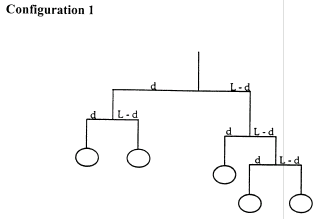
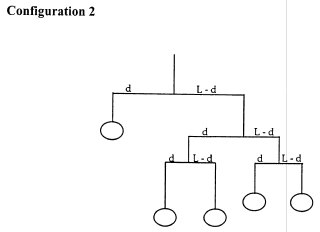
Using a metric balance, weigh all objects and bars except for the long one which will be used as the top bar.
Weigh objects to the nearest tenth of a gram. Measure the length of each bar to the nearest millimeter.
Record all your data in an organized table. Using the mathematical relationship between weights and
lengths, determine all the balance points for your mobile. You may use either of the configurations shown.
Now construct the mobile using fishing line or thread to tie the objects onto bars, moving them as close to
the end as possible. Hot glue or Elmer’s Glue-All works best. Use any lengths of string you wish as the
weights of the string are insignificant. Construct one of the mobile configuration as shown in the given
diagram so that “d” in each case is on the left. After completing the mobile, measure all the distances “d”
(left end of bar to point where it balances) in millimeters. These measurements can be called dm, the
measured distances. The ones obtained from the equations can be called dc, the calculated distances.
Subtract the two “d’s” and divide by L, the total length of the bar and convert to a percent. Do this for each set of
“d’s”. Find the mean (average) of these four percents to obtain the average or overall level of accuracy.
Notes to the teacher: Students will need to be familiar with the inverse relation between weight and length, as in the use of a fulcrum in a
lever. This relationship is w1d = w2(L-d) where:
- w1 = total weight hanging from the left side of the bar
- d = distance from the left end of the bar to the balance point
- w2 = total weight hanging from the right side of the bar.
- L = the total length of the bar
- (L-d) = length from the right side to the balance point.
Students will solve for d once the weights and total length of bar are substituted into the equation. The equation will need to be solved for
each of the four bars. As you move up to subsequent bars, note that the bars underneath become weights also. In each case, the total weights
from each end of the bar are used.
You may want to integrate this with a particular topic in art or math, for example, by having the objects be three-dimensional geometric
|