Gold Seal Lesson:
Game Time

Copernicus Education Gateway


Subject:

Mathematics

Grade:


5-8


ICLE Standards:


Mathematics as Problem Solving: Use problem-solving approaches to investigate and understand mathematical content.

Probability: Model situations by devising and carrying out experiments or situations
to determine probabilities.


Performance Task:


Note to the teacher: Each student, or pair of students, will need a spinner like the one shown.
The spinner shown is used in a child's game.
The outer ring is divided into three sections as follows:

  • 1/2 of the ring is yellow

  • 1/4 of the ring is green

  • 1/4 of the ring is red

  • The inner ring is divided into three sections as follows:

  • 1 is 3/8 of the ring

  • 2 is 1/2 of the ring

  • 3 is 1/8 of the ring

If the arrow is spun, it will land on both a number of the inner ring and a color of the outer ring. When the arrow is spun, what is the probability of it stopping on each color?
P(yellow) = _______ P(red ) = ________ P(green ) = _______
What is the probability of it stopping on each number?
P(1) = _______ P(2) = _______ P(3) = _______

  1. Explain why the probability of the spinner stopping on yellow or the number 1 is not 7/8 (1/2 + 3/8).

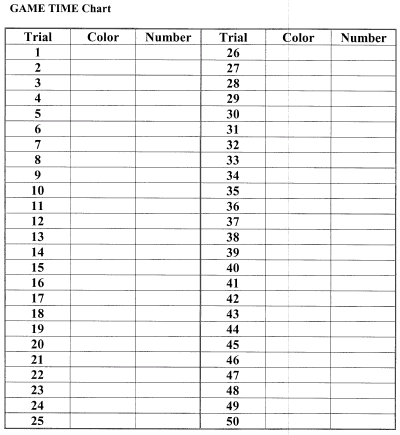
  2. Now spin the arrow 50 times and record the color and the number that the arrow stops on. Place your results on the accompanying chart.

  • How many times did it land on yellow or the number one? _______.

  • Using the results of your experiment, what is the probability of the arrow stopping on yellow or the number one? ________.

  • Is this greater or less than 1/2? _______; greater or less than 7/8?_______.

  • Why do you think this is so?

  1. Compute the probability that on any spin of the arrow it will stop on red or the number three: ________.

  • Using the chart made in part B, how many times did the arrow land on red or three? ________.

  • Using the results of your experiment, what is the probability of the arrow stopping on red or the number 3? ________.

  • How does this compare to your computed probability?

  • Why do you think this is so?

  1. If the arrow is spun twice, compute the probability that the arrow stops on green on the first spin and that it stops on yellow on the second spin: ________. Again, spin the arrow twice for 50 trials and record just the color that the arrow stops on each time.

  •  In how many of the 50 trials did the arrow first stop on green and then on yellow? ________.

  • Using the results of your experiment, what is the empirical probability that on two spins of the arrow, it will first land on green and then on yellow? _________.

  • How does this compare with your computed probability? Explain why.


Knowledge / Skills:


Understand the characteristic differences between theoretical and empirical probability (e.g., the theoretic probability of rolling a six an a die is 1/6; empirical probability is derived from repeated experimentation or accumulated statistics).  (m20)

Determine the probability of single and compound events using the basic premise that the probability of an event is equal to the number of ways it can occur divided by the total number of outcomes.  (m25)


Rubric:


4 Points  =  The student independently responds to all parts of the question. He/she demonstrates an understanding of probability concepts. The student completes the charts of trial spins and is able to make a correct connection between the empirical outcomes and theoretical probability concepts.


3 Points  =  The student needs some coaching to respond to all parts of the question. He/she has only a partial understanding of probability concepts. The student completes the charts of trial spins, but needs help to make a correct connection between the empirical outcomes and theoretical probability concepts.


2 Points  =  Even with coaching the student is unable to respond to all parts of the question. He/she demonstrates very little understanding of probability concepts. The student does not fully complete the chart of trial spins and is unable to make a correct connection between the empirical outcomes and theoretical probability concepts.


1 Point  =  The student is unable to complete the task. He/she shows no understanding of probability concepts. The student does not perform the trials necessary for the chart, and is, therefore, unable to make any connection between the empirical outcomes and theoretical probability concepts.


Keywords:


STATISTICS
DATA ANALYSIS
DATA COLLECTION
HYPOTHESIS TESTING
PREDICTION
PROBABILITY
PROBLEM SOLVING
TABLES
COMPUTATION


Grades:


Kg [] - 1 [] - 2 [] - 3 [] - 4 [] - 5 [X] - 6 [X] - 7 [X] - 8 [X] - 9 [] - 10 [] - 11 [] - 12 []


ICLE Application:


D


© 2000 International Center for Leadership in Education
1587 Route 146 - Rexford - NY - 12148
518.399.2776 Fax: 518.399.7607

65