Gold Seal Lesson:
Electronics Company

Copernicus Education Gateway


Subject:

Mathematics

Grade:


9-12


ICLE Standards:


Mathematics as Problem Solving: Apply the process of mathematical modeling to real-world problem situations.

Algebra: Represent situations that involve variable quantities with expression, equations, inequalities and matrices.

Discrete Mathematics: Represent and solve problems using linear programming.


Performance Task:


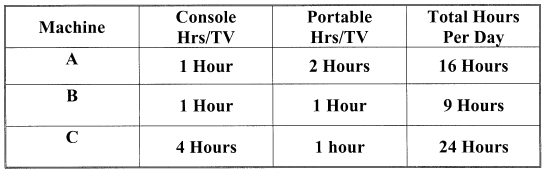
An electronics company makes $60 on each console TV and $40 on each portable TV it makes. It uses three machines - A, B and C - to produce the TVs. The table below gives the time for each day each machine requires to produce each kind of TV and the number of hours per day each machine is in production.

How many TVs of each type should be produced per day to maximize the profit?


Knowledge / Skills:


Understand the use of variables in expressions such as 4x, x+2, and 2x-1, solve for the variable, and know how to represent expressions such as "twice the number" or "four more than the number" using variables. (m7)

Understand the concepts and uses of matrices in modeling (i.e., finite graphs (structures) can be represented geometrically and interpreted algebraically in the form of a matrix). (m51)

Know how to find the graphic solution of systems of linear equations (e.g., find the point(s) common to a quadratic-linear pair)
(m71)

Understand the characteristics and uses of finite sequence and series (e.g., it allows a systematic and useful means of quantifying things). (m72)


Rubric:


4 Points = The student is able to independently solve the problem. He/she correctly expresses the relationships and constraints of the problem in algebraic terms. The feasible solution set drawn is accurately and neatly drawn. The student tests the corners of solution set to identify the values that produces the optimal value.


3 Points = The student is able to graph the feasible solution set, but needs assistance in writing the problem statements in correct mathematical language. He/she can read the corner points and test for optimal value.


2 Points = The student has difficulty completing all aspects of the problem. He/she lacks an understanding of how to translate the problem into algebraic language. The student’s graph is poorly constructed, making it difficult to read the corner points. Hence, he/she has incorrect corner points, resulting in an incorrect optimal value.


1 Point = The student, even with assistance, is unable to complete the problem. He/she lacks an understanding of all phases of solving a linear programming problem. There are major inaccuracies in the inequalities, the graphs and the coordinates of the corner points. No optimal value is obtained.


Keywords:


ALGEBRA
ALGEBRAIC OPERATIONS
LINEAR PATTERNS
PROBLEM SOLVING 
GRAPHS 
GRAPHING TECHNIQUES
MATH IN DAILY LIFE


Grades:


Kg [] - 1 [] - 2 [] - 3 [] - 4 [] - 5 [] - 6 [] - 7 [] - 8 [] - 9 [x] - 10 [x] - 11 [x] - 12 [x]


ICLE Application:


D


© 2000 International Center for Leadership in Education
1587 Route 146 - Rexford - NY - 12148
518.399.2776 Fax: 518.399.7607

61