|

|

|
Gold Seal Lesson:
Corvette!
Firebird! Mousetang!
|
|
|
|
Copernicus
Education Gateway
|
|
|
|
Subject:
|
|
|
Science
|
|
Grade:
|
|
|
5-8
|
|
|
|
|

|
|
ICLE Standards:
|
|
|
Science: Energy exists in many forms and, when
these forms change, energy is conserved.
Mathematics: Apply a variety of problem-solving
strategies while working through a technological process.
Technology: Technological systems are designed
to achieve specific results and produce outputs, such as
products, structures, services, energy or other systems.
|
|
|
|
|
|
|
Performance Task:
|
|
|
Note to the teacher: For this task, students are
required to have the following materials: One mousetrap, 5 meters of
string, four Lego figures, one Lego Kit not including motor, masking tape,
a tape measure. The students are to work in groups of three or four.
Your task is to design and construct a vehicle which will be powered by a
mousetrap. You are to use only materials provided by your teacher. Your
vehicle will be required to carry four figures over the longest possible
distance. The following conditions relate to the task:
- The mousetrap must be attached to the vehicle.
- The distance will be measured on a horizontal surface in a straight line
from the start to the finish.
You are to work with two or three other students in constructing your
vehicle. Spend some time discussing the pros and cons of your prospective
design and, then as a team, design what you feel to be the optimum vehicle.
Construct the vehicle and test drive it. Make at least three trial runs.
Measure the distance traveled in a straight line. The "maximum
distance" will be the average of your three best runs. Record all your
data and show any work you do in completing the task. The group achieving
the "maximum distance" will be the winner of the Mousetang 5000!
|
|
|
|
|
|
|
Knowledge / Skills:
|
|
|
Plan and apply real or hypothetical models and
constructions to facilitate investigation and learning and the solution to
practical problems. (xs2)
Understand the concepts and uses of machines
(e.g., levers and pulleys). (s49)
Understand and apply statics (i.e., the relation
between forces acting on an object at rest) and dynamics (i.e., the
relation between the forces acting on an object and the resulting
motion). (s84)
Use brainstorming, role playing, and standard
problem solving strategies to define a problem and suggest solutions. (ela19)
|
|
|
|
|
|
|
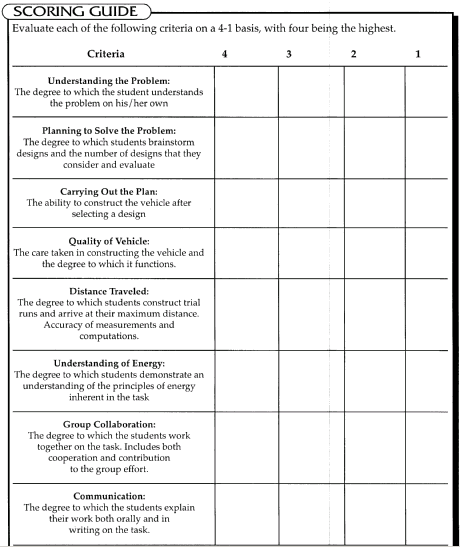
Rubric:
|
|
|
|
|
|
|
|
|
|
Keywords:
|
|
|
MECHANICS
MOTION
SIMPLE MACHINES
PHYSICS
TECHNOLOGY INTEGRATION
MODELS & CONSTRUCTIONS
LIFE SCIENCE
|
|
|
|
|
|
|
Grades:
|
|
|
Kg [] - 1 [] - 2 [] - 3 [] - 4 [] - 5 [X]
- 6 [X] - 7 [X] - 8 [X] - 9 [] - 10 [] - 11 [] - 12 []
|
|
|
|
|
|
|
ICLE Application:
|
|
|
D
|
|
|
|
|
|
|
|
|
|
© 2000 International
Center for Leadership in Education
1587 Route 146 - Rexford - NY - 12148
518.399.2776 Fax: 518.399.7607
21
|
|
|
|
|
|
|