|

|

|
Gold Seal Lesson:
Checkerboard
Puzzle
|
|
|
|
Copernicus
Education Gateway
|
|
|
|
Subject:
|
|
|
Mathematics
|
|
Grade:
|
|
|
5-8
|
|
|
|
|

|
|
ICLE Standards:
|
|
|
Geometry: Visualize and represent geometric
figures with special attention to developing spatial sense.
Measurement: Use measurement devices to
construct geometric figures; develop spatial sense.
Statistics: Collect, organize and describe data;
construct, read and interpret graphs.
|
|
|
|
|
|
|
Performance Task:
|
|
|
In this task you will design and construct a jigsaw
puzzle, collect and analyze data, construct graphs of data and write a report of your project. Use the following procedure:
Part I: Design and Construct a Jigsaw Puzzle
- Construct a square 5 inches on each side.
- Grid the square into 25 one inch by one inch squares.
- Select any two different colors and color the grid making a checkerboard
pattern.
- Cut the grid into six to nine irregularly shaped sections, each
containing three to six of the 1 inch-by-1 inch squares. The sections should not be squares or rectangles.
Part II: Data Collection
Mix up your puzzle pieces and have other students in your class reassemble
them into the checkerboard. You should have at a minimum of 10 students in class do this. Accurately
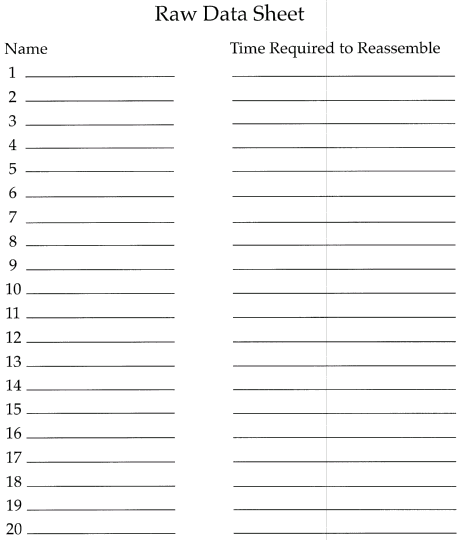
measure and record on the Raw Data Sheet (attached) the time required for each student to reassemble
the puzzle.
Part III: Organize, Display, and Analyze the Data
- Make a chart and at least 2 different graphs (line, bar, pi, stem and
leaf plot, box plots, etc.) to display the data you collect.
- Compare and analyze the data collected and displayed in your graphs.
Part IV: Written Report
- Write a detailed summary of your project, including a written comparison
and analysis of the data you collected.
- State whether you think your puzzle is too easy or too difficulty.
Justify your statement.
- State how you could make your puzzle easier or harder.
- State what you learned, if anything, from the activity.
|
|
|
|
|
|
|
Knowledge / Skills:
|
|
|
Perform operations with signed (positive and
negative) numbers, including decimals, ratios, percents, and fractions. (m1)
Understand the best procedures for statistical
data collection, organization, and display. (m5)
Compute the perimeter and area of
two-dimensional figures. (m13)
Use the technique of dimensional analysis to
convert units of measure (e.g., convert km/hr to m/min). (m33)
Plan and apply real or hypothetical models and
constructions to facilitate investigation and learning and the solution to
practical problems. (s115)
Use expository writing skills in subjects other
than English language arts. (ela58)
|
|
|
|
|
|
|
Rubric:
|
|
|
4 Points =
All four parts of the task are completed. The task was well
executed, neat and accurate. The puzzle created is nicely made and
challenging to others. The Raw Data Sheet is complete with a minimum of 10 students. It is legible. At least two accurate and neat graphs are
constructed. The student makes a meaningful comparison and analysis of the data. The written report is
thorough, well organized and understandable.
3 Points = All four parts of the task are
completed. The puzzle was neatly constructed, but was either too
complicated or much too easy. The Raw Data Sheet is complete with the
minimum of 10 students, but the entries are not very neat. Two graphs are constructed, but they are
not neat and/or contain some inaccuracies. The comparison and analysis of data is simply stated,
but adequate. The written report is complete, but not well written.
2 Points = All four parts of the task are
completed. The puzzle is not well constructed, making it difficult for
others to reassemble. Fewer than the minimum 10 students are on the Raw
Data Sheet. Two graphs are constructed, but they are carelessly made. The written report is vague
and shows a lack of good language arts skills.
1 Point = At least one part of the task is missing. The puzzle is very poorly
constructed, making it almost impossible for others to reassemble. Only about five students are included
on the
|
|
|
|
|
|
|
Keywords:
|
|
|
GEOMETRY
SPATIAL SENSE
DATA ANALYSIS
DATA COLLECTION
GRAPHS
MEASUREMENT
PROBLEM SOLVING
COMPUTATION
DATA DISPLAY
CALCULUS
MODELS & CONSTRUCTION
EXPOSITION
|
|
|
|
|
|
|
Grades:
|
|
|
Kg [] - 1 [] - 2 [] - 3 [] - 4 [] - 5 [x] - 6 [] - 7 [x] - 8 [x] - 9 [] - 10 [] - 11 [] - 12 []
|
|
|
|
|
|
|
ICLE Application:
|
|
|
D
|
|
|
|
|
|
|
|
|
|
© 2000 International
Center for Leadership in Education
1587 Route 146 - Rexford - NY - 12148
518.399.2776 Fax: 518.399.7607
57
|
|
|
|
|
|
|